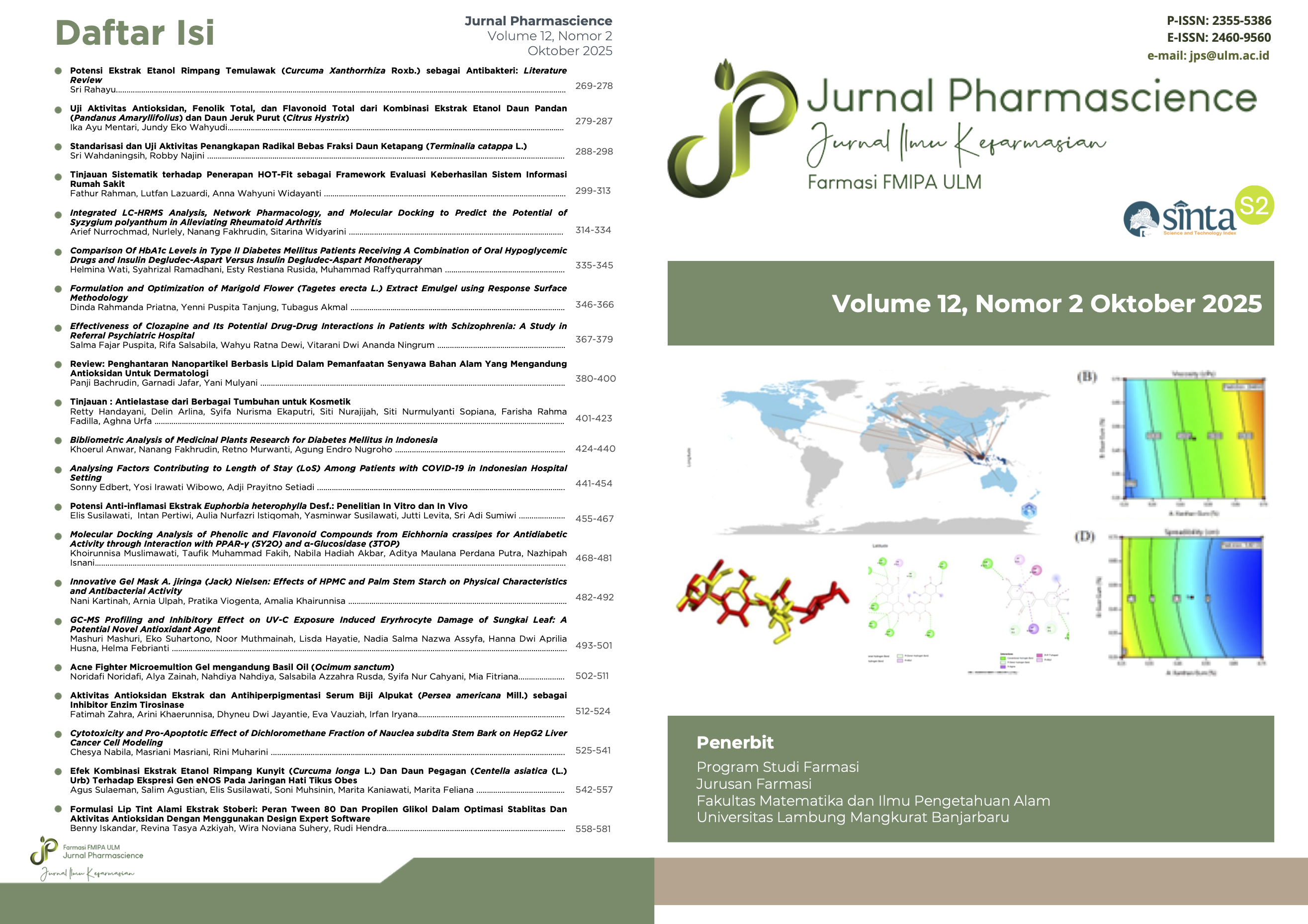
Effectiveness of Clozapine and Its Potential Drug-Drug Interactions in Patients with Schizophrenia: A Study in Referral Psychiatric Hospital
DOI:
https://doi.org/10.20527/jps.v12i2.23111Keywords:
Clozapine, Schizophrenia, Effectiveness, Influencing Factor, Drug-Drug InteractionsAbstract
ABSTRAK Penelitian terkait efektivitas klozapin pada populasi Asia, baik sebagai monoterapi atau kombinasi, masih sangat terbatas. Selain itu, potensi interaksi antar-obat sering dijumpai pada pasien skizofrenia. Penelitian ini bertujuan untuk menganalisis respon terapeutik klozapin dan faktor-faktor yang memengaruhinya, serta interaksi obat-obat yang bersifat potensial. Penelitian cross-sectional retrospektif ini menggunakan data sekunder dari rekam medik pasien di rumah sakit jiwa rujukan di Jawa Tengah, Indonesia. Analisis data menggunakan uji Chi-square atau Fisher’s exact dengan SPSS versi 23. Studi melibatkan 149 pasien skizofrenia dengan mayoritas laki-laki dan terdiagnosis undifferentiated schizophrenia. Sebanyak 89,93% pasien mengalami perbaikan gejala klinis, sesuai yang dinyatakan dokter pada rekam medik, baik pada penggunaan klozapin tunggal maupun kombinasi terutama dengan risperidon. Respon terapeutik klozapin dipengaruhi secara signifikan hanya oleh usia (p<0,05). Sementara itu, interaksi obat potensial dengan klozapin berkategori mayor ditemukan pada 8,1% pasien. Penggunaan bersama risperidon diidentifikasi sebagai interaksi obat mayor terbanyak (79,25%) yang berisiko menimbulkan permasalahan kardiovaskular atau pernapasan. Penelitian ini merekomendasikan studi prospektif dengan penilaian efektivitas klozapin menggunakan PANSS-ES maupun dampak klinis interaksi obatnya. Kata Kunci: Klozapin, Skzofrenia, Efektivitas, Faktor Yang Memengaruhi, Interaksi Obat-Obat  Studies on clozapine effectiveness among Asian populations, either as monotherapy or in combination, are quite limited. In addition, potential drug-drug interactions (DDI) are common in schizophrenic patients. This study aimed to analyze the therapeutic response to clozapine, its influencing factors, and the potential DDI. A cross-sectional study design retrospectively collected secondary data from medication records at the referral psychiatric hospitals in Central Java, Indonesia. Data analysis was performed using the Chi-square test or Fisher's exact test in SPSS version 23.  This study included 149 patients, predominantly male, who were diagnosed with undifferentiated schizophrenia. As many as 89.93% of patients experienced symptom improvement, as stated by the physician in the medical record, either as monotherapy or in combination, especially with risperidone. The therapeutic response to clozapine was significantly influenced only by age (p<0.05). Meanwhile, potential major drug interactions were found in 8.1% of patients. The combined use of clozapine with risperidone has been identified as having the most significant risk for drug interactions (79.25%), which can lead to cardiovascular or respiratory problems. This study recommends conducting prospective studies on the effectiveness of clozapine using the PANSS-ES scale and examine the clinical impact of the drug interactions.References
Aichhorn, W., Weiss, U., Marksteiner, J., Kemmler, G., Walch, T., Zernig, G., Stelzig-Schoeler, R., Stuppaeck, C., & Geretsegger, C. (2005). Influence of age and gender on risperidone plasma concentrations. Journal of Psychopharmacology (Oxford, England), 19(4), 395–401. https://doi.org/10.1177/0269881105053306
Barber, S., Olotu, U., Corsi, M., & Cipriani, A. (2017). Clozapine combined with different antipsychotic drugs for treatmentâ€resistant schizophrenia. The Cochrane Database of Systematic Reviews, 2017(3), CD006324. https://doi.org/10.1002/14651858.CD006324.pub3
Brand, B. A., de Boer, J. N., & Sommer, I. E. C. (2021). Estrogens in schizophrenia: Progress, current challenges and opportunities. Current Opinion in Psychiatry, 34(3), 228–237. https://doi.org/10.1097/YCO.0000000000000699
Brand, B. A., Haveman, Y. R. A., de Beer, F., de Boer, J. N., Dazzan, P., & Sommer, I. E. C. (2021). Antipsychotic medication for women with schizophrenia spectrum disorders. Psychological Medicine, 52(4), 649–663. https://doi.org/10.1017/S0033291721004591
Chai, A. B., Callaghan, R., & Gelissen, I. C. (2022). Regulation of P-Glycoprotein in the Brain. International Journal of Molecular Sciences, 23(23), Article 23. https://doi.org/10.3390/ijms232314667
El Abdellati, K., De Picker, L., & Morrens, M. (2020). Antipsychotic Treatment Failure: A Systematic Review on Risk Factors and Interventions for Treatment Adherence in Psychosis. Frontiers in Neuroscience, 14. https://www.frontiersin.org/articles/10.3389/fnins.2020.531763
Goodman, C. W., & Brett, A. S. (2021). Race and Pharmacogenomics—Personalized Medicine or Misguided Practice? JAMA, 325(7), 625–626. https://doi.org/10.1001/jama.2020.25473
Harjaningsih, W., Ayunirrahmah, L., & Putri, N. J. V. (2021). IAI CONFERENCE: The therapeutic outcomes and adverse drug reactions study of Clozapine on Schizophrenia inpatients in the Grhasia psychiatric hospital Yogyakarta, Indonesia. Pharmacy Education, 21(2), Article 2. https://doi.org/10.46542/pe.2021.212.287295
Hoekstra, S., Bartz-Johannessen, C., Sinkeviciute, I., Reitan, S. K., Kroken, R. A., Løberg, E.-M., Larsen, T. K., Rettenbacher, M., Johnsen, E., & Sommer, I. E. (2021). Sex differences in antipsychotic efficacy and side effects in schizophrenia spectrum disorder: Results from the BeSt InTro study. NPJ Schizophrenia, 7, 39. https://doi.org/10.1038/s41537-021-00170-3
Kloosterboer, S. M., de Winter, B. C. M., Reichart, C. G., Kouijzer, M. E. J., de Kroon, M. M. J., van Daalen, E., Ester, W. A., Rieken, R., Dieleman, G. C., van Altena, D., Bartelds, B., van Schaik, R. H. N., Nasserinejad, K., Hillegers, M. H. J., van Gelder, T., Dierckx, B., & Koch, B. C. P. (2021). Risperidone plasma concentrations are associated with side effects and effectiveness in children and adolescents with autism spectrum disorder. British Journal of Clinical Pharmacology, 87(3), 1069–1081. https://doi.org/10.1111/bcp.14465
Knox, E. G., Aburto, M. R., Clarke, G., Cryan, J. F., & O’Driscoll, C. M. (2022). The blood-brain barrier in aging and neurodegeneration. Molecular Psychiatry, 27(6), Article 6. https://doi.org/10.1038/s41380-022-01511-z
Kuzo, N., Haen, E., Ho, D. M., Takeuchi, H., Piras, M., Eap, C.-B., de Filippis, R., Homan, P., Kane, J. M., Roy, M.-A., Paulzen, M., & Schoretsanitis, G. (2022). Clozapine once- versus multiple-daily dosing: A two-center cross-sectional study, systematic review and meta-analysis. European Archives of Psychiatry and Clinical Neuroscience. https://doi.org/10.1007/s00406-022-01542-1
Li, X., Zhou, W., & Yi, Z. (2022). A glimpse of gender differences in schizophrenia. General Psychiatry, 35(4), e100823. https://doi.org/10.1136/gpsych-2022-100823
Naveen, M., Patil, A. N., Pattanaik, S., Kaur, A., Banerjee, D., & Grover, S. (2020). ABCB1 and DRD3 polymorphism as a response predicting biomarker and tool for pharmacogenetically guided clozapine dosing in Asian Indian treatment resistant schizophrenia patients. Asian Journal of Psychiatry, 48, 101918. https://doi.org/10.1016/j.ajp.2019.101918
Olafuyi, O., Parekh, N., Wright, J., & Koenig, J. (2021). Interâ€ethnic differences in pharmacokinetics—Is there more that unites than divides? Pharmacology Research & Perspectives, 9(6), e00890. https://doi.org/10.1002/prp2.890
Ortizâ€Orendain, J., Obeso, S. C., Colungaâ€Lozano, L. E., Hu, Y., Maayan, N., & Adams, C. E. (2017). Antipsychotic combinations for schizophrenia. Cochrane Database of Systematic Reviews, 6. https://doi.org/10.1002/14651858.CD009005.pub2
Pai, N., Acar, M., Juneja, P., Kouhkamari, M. H., Siva, S., & Mullan, J. (2022). Antipsychotic prescribing patterns in Australia: A retrospective analysis. BMC Psychiatry, 22(1), 110. https://doi.org/10.1186/s12888-022-03755-z
Parks, K. A., Parks, C. G., Yost, J. P., Bennett, J. I., & Onwuameze, O. E. (2018). Acute Blood Pressure Changes Associated With Antipsychotic Administration to Psychiatric Inpatients. The Primary Care Companion for CNS Disorders, 20(4), 26587. https://doi.org/10.4088/PCC.18m02299
Procyshyn, R. M., Vila-Rodriguez, F., Honer, W. G., & Barr, A. M. (2014). Clozapine administered once versus twice daily: Does it make a difference? Medical Hypotheses, 82(2), 225–228. https://doi.org/10.1016/j.mehy.2013.11.043
Ruan, C.-J., Zang, Y.-N., Wang, C.-Y., Cheng, Y.-H., Sun, C., Spina, E., & de Leon, J. (2019). Clozapine Metabolism in East Asians and Caucasians: A Pilot Exploration of the Prevalence of Poor Metabolizers and a Systematic Review. Journal of Clinical Psychopharmacology, 39(2), 135. https://doi.org/10.1097/JCP.0000000000001018
Schoretsanitis, G., Kane, J. M., Correll, C. U., Marder, S. R., Citrome, L., Newcomer, J. W., Robinson, D. G., Goff, D. C., Kelly, D. L., Freudenreich, O., Piacentino, D., Paulzen, M., Conca, A., Zernig, G., Haen, E., Baumann, P., Hiemke, C., Gründer, G., Psychopharmacology, A. S. of C., & Pharmakopsychiatrier, T. D. M. T. F. of the A. für N. und. (2020). Blood Levels to Optimize Antipsychotic Treatment in Clinical Practice: A Joint Consensus Statement of the American Society of Clinical Psychopharmacology and the Therapeutic Drug Monitoring Task Force of the Arbeitsgemeinschaft für Neuropsychopharmakologie und Pharmakopsychiatrie. The Journal of Clinical Psychiatry, 81(3), 3649. https://doi.org/10.4088/JCP.19cs13169
Siafis, S., Tzachanis, D., Samara, M., & Papazisis, G. (2018). Antipsychotic Drugs: From Receptor-binding Profiles to Metabolic Side Effects. Current Neuropharmacology, 16(8), 1210–1223. https://doi.org/10.2174/1570159X15666170630163616
Siskind, D., Sharma, M., Pawar, M., Pearson, E., Wagner, E., Warren, N., & Kisely, S. (2021). Clozapine levels as a predictor for therapeutic response: A systematic review and meta-analysis. Acta Psychiatrica Scandinavica, 144(5), 422–432. https://doi.org/10.1111/acps.13361
Solmi, M., Radua, J., Olivola, M., Croce, E., Soardo, L., Salazar de Pablo, G., Il Shin, J., Kirkbride, J. B., Jones, P., Kim, J. H., Kim, J. Y., Carvalho, A. F., Seeman, M. V., Correll, C. U., & Fusar-Poli, P. (2022). Age at onset of mental disorders worldwide: Large-scale meta-analysis of 192 epidemiological studies. Molecular Psychiatry, 27(1), Article 1. https://doi.org/10.1038/s41380-021-01161-7
Sulejmanpasic, G., & Bise, S. (2017). Clozapine augmented with risperidone in treatment-resistant schizophrenia. European Psychiatry, 41, S385. https://doi.org/10.1016/j.eurpsy.2017.02.424
Takeuchi, H., Powell, V., Geisler, S., DeSanti, M., Fervaha, G., Agid, O., Kane, J. M., & Remington, G. (2016). Clozapine administration in clinical practice: Once-daily versus divided dosing. Acta Psychiatrica Scandinavica, 134(3), 234–240. https://doi.org/10.1111/acps.12593
Thorn, C. F., Müller, D. J., Altman, R. B., & Klein, T. E. (2018). PharmGKB Summary: Clozapine Pathway, Pharmacokinetics. Pharmacogenetics and Genomics, 28(9), 214–222. https://doi.org/10.1097/FPC.0000000000000347
Wagner, E., Siafis, S., Fernando, P., Falkai, P., Honer, W. G., Röh, A., Siskind, D., Leucht, S., & Hasan, A. (2021). Efficacy and safety of clozapine in psychotic disorders—A systematic quantitative meta-review. Translational Psychiatry, 11(1), Article 1. https://doi.org/10.1038/s41398-021-01613-2
Walters, S. H., & Levitan, E. S. (2020). Vesicular Antipsychotic Drug Release Evokes an Extra Phase of Dopamine Transmission. Schizophrenia Bulletin, 46(3), 643–649. https://doi.org/10.1093/schbul/sbz085
Williams, O. O. F., Coppolino, M., George, S. R., & Perreault, M. L. (2021). Sex Differences in Dopamine Receptors and Relevance to Neuropsychiatric Disorders. Brain Sciences, 11(9), 1199. https://doi.org/10.3390/brainsci11091199
Willner, K., Vasan, S., & Abdijadid, S. (2023). Atypical Antipsychotic Agents. In StatPearls. StatPearls Publishing. http://www.ncbi.nlm.nih.gov/books/NBK448156/
Downloads
Published
Issue
Section
License

This work is licensed under a Creative Commons Attribution-NonCommercial 4.0 International License.

.jpg)