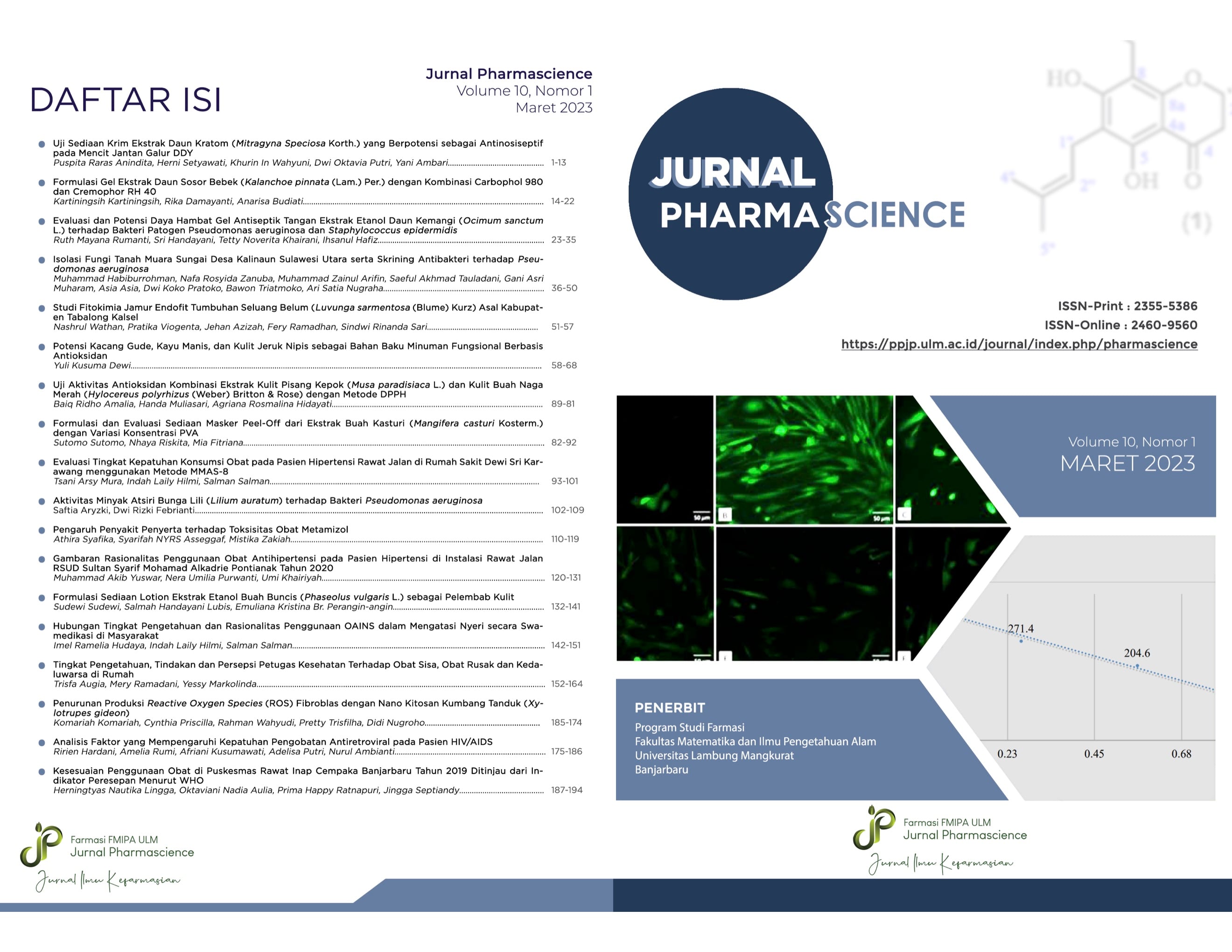
Penurunan Produksi Reactive Oxygen Species (ROS) Fibroblas dengan Nano Kitosan Kumbang Tanduk (Xylotrupes gideon)
DOI:
https://doi.org/10.20527/jps.v10i1.15006Keywords:
Nano Chitosan, X. gideon, ROS, Fibroblasts, FluorescentAbstract
Fibroblas berperan dalam proses penyembuhan luka dengan pembentukan pembuluh darah, penggerakan serta proliferasi, deposit matriks ekstraseluler dan remodeling jaringan. Pada penyembuhan luka, netrofil dan makrofag akan mengalami peningkatan penggunaan oksigen sehingga memproduksi ROS, peningkatan produk ini akan menyebabkan stres oksidatif pada fibroblas yang akan mempengaruhi proses migrasi dan proliferasi selama proses penyembuhan luka. Kandungan gugus amino (-NH2) dan gugus hidroksil (-OH) pada nano kitosan mampu mengurangi stres oksidatif fibroblas. Penelitian bertujuan untuk mengetahui kemampuan nano kitosan X. gideon dalam menurunkan produksi ROS fibroblas. Penelitian terbagi menjadi enam kelompok terdiri dari kontrol negatif (H2O2), kontrol pembanding, kontrol asam askorbat, nano kitosan konsentrasi 200, 400, dan 600 µg/mL. Produksi ROS dilihat menggunakan probe 2′,7′-Dichlorodihydrofluorescein diacetate (H2DCF-DA). Produksi fibroblas diperlihatkan dengan intensitas fibroblas terflouresen hijau dihitung menggunakan software image J. Rerata produksi ROS pada kelompok nano kitosan 200, 400, dan 600 µg/mL berbeda signifikan dengan kontrol negatif (p<0,05), sedangkan yang diberikan asam askorbat tidak signifikan (p>0,05) dengan perlakuan 200 dan 600 µg/mL, namun signifikan dengan nano kitosan 400 µg/mL. Nano kitosan X. gideon mampu menurunkan produksi ROS fibroblas pada konsentrasi 400 µg/mL. Kata Kunci: Nano Kitosan, X. gideon, ROS, Fibroblas, Fluoresen  Fibroblasts play a role in wound healing by forming blood vessels, mobilizing and proliferation, depositing extracellular matrix and tissue remodelling. In wound healing, neutrophils and macrophages will experience an increase in oxygen use, resulting in ROS production. An increase in these products will cause oxidative stress in fibroblasts, affecting the migration and proliferation processes during the wound healing process. The content of amino groups (-NH2) and hydroxyl groups (-OH) in nano chitosan can reduce fibroblast oxidative stress. This study aimed to determine the ability of X. gideon nano chitosan to reduce fibroblast ROS production. The study was divided into six groups: negative control (H2O2), control control, ascorbic acid control, and nano chitosan concentrations of 200, 400 and 600 µg/mL. ROS production observes using the 2′,7′-Dichlorodihydrofluorescein diacetate (H2DCF-DA) probe. The intensity of greenfluorescent fibroblasts calculated using Image J software showed the production of fibroblasts. The mean ROS production in the 200, 400, and 600 µg/mL nano-chitosan groups was significantly different from the negative control (p<0.05), whereas those given ascorbic acid were insignificant. (p>0.05) with 200 and 600 µg/mL treatments, but significant with 400 µg/mL nano chitosan. X. gideon nano chitosan reduced fibroblast ROS production at 400 µg/mL concentration.References
Anura, A. (2014). Traumatic oral mucosal lesions: a mini review and clinical update. Oral Health and Dental Management, 13(2), 254-9.
Arief, H., & Widodo, M.A. (2018). Rules of oxidative stress in wound healing. Jurnal Ilmu Kedokt Wijaya Kusuma, 5(2), 22-29.
Bhattacharyya, A., Chattopadhyay, R., Mitra, S., & Crowe, S.E. (2014). Oxidative stress: An essential factor in the pathogenesis of gastrointestinal mucosal diseases. Physiological Reviews, 94(2),329–354.
Cheung, R.C.F., Ng, T.B., Wong, J.H., & Chan, W.Y. (2015). Chitosan: an update on potential biomedical and pharmaceutical applications. Marine Drugs,13, 5156-5186.
Deng, L., Du, C., Song, P., Chen, T., Rui, S., Armstrong, D.G, et al. (2021). The Role of Oxidative Stress and Antioxidants in Diabetic Wound Healing. Oxidative Medicine and Cellular Longevity. 2021.
Ekmekcioglu, H., & Unur, M. (2017). Eye- related trauma and infection in dentistry. Journal of Istanbul University Faculty of Dentistry,51(3),55-63.
Gabbott, C.M., & Sun, T. (2018). Comparison of human dermal fibroblasts and HaCat cells cultured in medium with or without serum via a generic tissue engineering research platform. International Journal of Molecular Sciences,19(2), 388-405.
Gonzales, A.C., Costa, T.F., Andrade, Z.A., & Medrado, A.R.A.P. (2016). Wound healing: literature review. Anais Brasileiros de Dermatologia, 91(5),614-620.
Gouzos, M., Ramenzanpour, M., Bassiouni A., Psaltis, A.J., Wormald, P.J., Vreugde, S. (2020). Antibiotics affect ROS production and fibroblast migration in an in-vitro model of sinonasal wound healing. Frontiers in Cellular and Infection Microbiology,19(10),110.
Ilina, A.V., & Varlamov, V.P. (2016). Neutralization of reactive oxygen species by chitosan and its derivatives in vitro/in vivo: review. Applied Biochemistry and Microbiology, 52(1), 1-14.
Irawan, C. (2018). The effect of adsorbate concentration on the effectiveness of decreasing Fe using fly ash as adsorben. Seminastika, 291-293.
Juan, C.A., Lastra, J.M.P., Plou, F.J., & Pérez-Lebeña, E. (2021). The Chemistry of Reactive Oxygen Species (ROS) Revisited: Outlining Their Role in Biological Macromolecules (DNA, Lipids and Proteins) and Induced Pathologies. International Journal of Molecular, 22(9), 4642
Komariah, A., Laksono, W.A., Bustami, D.A., & Trenggono, B.S. (2017). Effects chitosan and calcium nanoparticles mouthwash from Xylotrophes gideon in the liver and kidney rat. Res J Pharmaceutical, Biological and Chemical Sciences, 8(1), 1-9.
Komariah, K., & Astuti, L. (2012). Preparasi dan karakterisasi kitin yang terkandung dalam eksoskeleton kumbang tanduk Rhinoceros Beetle (Xylotrupes gideon) dan kutu beras (Sitophilus Oryzae L). Seminar Nasional IX Pendidikan Biologi FKIP UNS 2012 (SEMBIO).
Komariah, K. (2013). Karakterisasi kitin dan kitosan yang terkandung dalam eksoskeleton kutu beras (Sitophilus oryzae). Seminar Nasional IX Pendidikan Biologi FKIP UNS 2013 (SEMBIO).
Komariah, K. (2020). Proses pembuatan nano kitosan dari rhinoceros beetle dan komposisinya sebagai obat kumur antiseptik [Paten]. P00201507360. 12 Mei 2020.
Kurniawati, Y., Adi, S., Achadiyani, Suwarsa, O., Erlangga, D., & Putri, T. (2015). Kultur primer fibroblas: penelitian pendahuluan. Majalah Kedokteran Andalas, 38(1), 33-40.
Masir, O., Manjas, M., Putra, A.E., & Agus, S. (2012). Pengaruh cairan cultur filtrate fibroblast (CFF) terhadap penyembuhan luka: penelitian eksperimental pada rattus novegicus galur wistar. Jurnal Kesehatan Andalas, (3),112-117.
Nita, M., & Grzybowski, A. (2016). The Role of the Reactive Oxygen Species and Oxidative Stress in the Pathomechanism of the Age-Related Ocular Diseases and Other Pathologies of the Anterior and Posterior Eye Segments in Adults. Oxidative Medicine and Cellular Longevity, 1-23.
Padayatty, S.J., Katz, A., Wang, Y., Eck, P., Kwon, O., Lee, J.H, et al. (2014). Vitamin C as an antioxidant: evaluation of its role in disease prevention. Journal of the American Nutrition Association, 22(1),18-35.
Patil, P.S., & Leipzig, N.D. (2018). Fluorinated methacrylamide chitosan sequesters reactive oxygen species to relieve oxidative stress while delivering oxygen. Journal of Biomedical Materials Research, 105(8), 2368-2374.
Phaniendra, A., Jestadi, D.B., & Periyasamy, L. (2015). Free Radicals: Properties, Sources, Targets, and Their Implication in Various Diseases. Indian Journal of Clinical Biochemistry,30(1),11–26.
Pisoschi, A.M., & Pop, A. (2015). The role of antioxidants in the chemistry of oxidative stress: A review. European Journal of Medicinal Chemistry,97:55–74.
Sudha, P.N., Gomathi, T., & Aisverya, S. (2015). Recent research in the applications of chitin, chitosan and oligosaccharides. Green Polymers and Environmental Pollution Control, Chapter 10, Department of Chemistry, D.K.M. College for Women, Thiruvalluvar University, Vellore, Tamilnadu, India 303-333.
Tsuneda,T. (2020). Fenton reaction mechanism generating no OH radicals in Nafon membrane decomposition. Scientifc Reports,10:18144.
Veronica, G., Komariah, K., & Maria, G.C. (2021). Microencapsulation of Lemongrass Leaves Effect on Reactive Oxygen Species (ROS) Fibroblasts. International Conference on Health, Instrumentation & Measurement, and Natural Sciences (InHeNce). DOI: 10.1109/InHeNce52833.2021.9537219.
Wells, A., Nuschke, A., & Yates, C.C. (2016). Skin tissue repair: matrix microenvironmental influences. Matrix Biology, 49, 1-20.
Wibawaa, J.C., Arifin, M.Z., & Herawatia, L. (2020). Mekanisme Vitamin C Menurunkan Stres Oksidatif Setelah Aktivitas Fisik. Journal of Sport Science and Education,5(1),57-63.
Yuslianti, E.R., Bachtiar, B.M., Suniarti, D.F., Sutjiatmo, A.B. (2015). Effect of topical rambutan honey pharmaceutical grade on oral mucosa wound healing based on tissue wound closure and fibroblasts proliferation in vivo. International Journal of Pharmacology,11(7),864-869.
Downloads
Published
Issue
Section
License

This work is licensed under a Creative Commons Attribution-NonCommercial 4.0 International License.

.jpg)